Blog Keywords

Popular Posts for the Month

Saturday, January 10, 2009

E-30 and ART Filters: PALE & LIGHT COLOR


To tell you the truth, this is one filter that I was having trouble figuring out. Olympus described it as, "Utilizes muted colour tonalities to create a gentle light. The subject floats serenely in its own world, like a misty memory or the landscape of a dream." Somehow, after reading its meaning, I was more confused.

I had shot various scenes with this effect, and I struggled to get the most out of it.

Well, as a last resort, I tried to shoot some controlled environment subjects. In this case, I specifically shot a flower from a very low angle to have the blue sky as the dominant background. It was early morning, and sun was shining brightly and directly onto the flower. This had resulted in a very high contrast situation. To counter this, I had to utilize the wireless TTL flash capabilities on the E-3o. With the FL-50R nicely perched under the flower (with a diffuser to spread the flash light), the contrast was balanced. Also, since the shutter speed was much higher than 1/250s, all I did was to activate the FP TTL mode. Perfect!

Again, using the free-angle live view capability, I handheld the camera below my knees whilst directly looking at the LCD screen. The responsive AF from the 14-54mk2 ensured the subject was sharp in focus.

As could be seen, the colors were pale and muted. Almost milky. And the flowers seemed to stand out more than the original image.


Somehow, the original image looks a bit overworked.


Actually there's nothing wrong with the original image, as it was only the typical 1:1 flash lighting ratio.

Please click on image for larger view.
Comparison between Pale & Light Color with normal setting.

E-30 and ART Filters: SOFT FOCUS

I was having a meet up with my 2 siblings, and took them for a tea break at one of the nearest "kopi tiam". After having a nice dose of "tiam" food, they started to surf on my phone looking for some cool stuff on Youtube. Their expressions said it all. Total attention with the Alfa Romeo 159 performance, I assume.


I quickly setup my gig. By whipping out the E-30 with the 14-54mk2, I saw the opportunity to do some Soft Focus images. The soft ambient light particularly from the open window, strong backlight to whitewash any potential "garbage" background, with elegant but classic furnishing completed the scene.


Ahh... this shot was also using the Free-angle Live View, if you noticed the slight high-angle shot. I was sitting in front of them, still enjoying my drink. A quick snapshot again, stealthily as possible.


With the original image, the facial details were apparent, and looks very gritty indeed. The soft focus filter can be a great tool for wedding photographers to get that "aura look" straight out of the camera.


From the E-30 website: "The soft tone creates an ethereal, otherworldly atmosphere for beautiful images with a fantasy-like feel." The subtleties were minor, but when combined in an image, they became a strong effect to the final output.


Please click on image for larger view.

Comparison between Soft Focus and normal output.

E-30 and ART Filters: POP ART


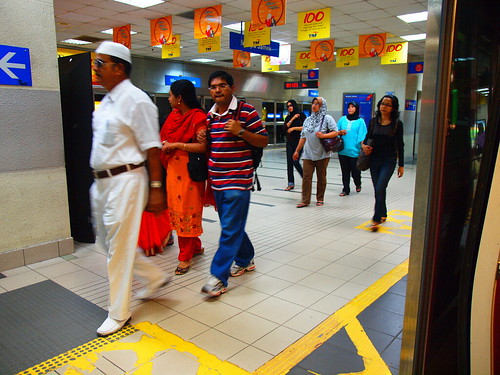
One of my first images I made with the E-30 was during my LRT ride from KL Sentral to KLCC. With the 14-54mk2 attached, and flipped the free-angle LCD with Live View, I was able to capture some nice shots at waist level without much annoyance to the crowd. And contrast-detect AF, similar to P&S cameras, was super responsive.

While stopping at Masjid Jamek station, I noticed the colorful banners and signages adorning its hallway, and I realized this was a great opportunity to make the colors jump out. By pressing the OK button, the ART Menu appeared in the LCD screen. A quick scroll using the D-pad enabled me to lock into ART1 Pop Art. A quick reminder, whenever in the ART mode, the camera will be on the P-mode AE. No worries, you can program to Ps with one of the dials, and it will work like A or S mode.

Snap! (rather a "ka-chik" mirror and shutter slaps)... and presto!


In comparison, the original image based on the Vivid mode setting.


Now, let me do some sanity check. From what I read at the Olympus website, this was the explanation: "This effect enhances colours, making them stronger and more vivid, creating high-impact pictures with a pop art feeling."

I could not agree more!

Please click on image for larger view.

Comparison between Pop Art and normal output.

Friday, January 9, 2009

E-30: A Short Review


I got the E-30 on Wednesday, and straight away went out for some shooting session. Being coy, I had explicitly asked for the ultra-wide angle Zuiko Digital ED 9-18mm F4-5.6 together with the E-30 and Zuiko Digital 14-54mm f2.8-3.5 II kit.

The first thing that caught my eyes was how small the 9-18mm. It was really petite! Just look at it! It was gorgeous.

Wooops, before I get way over my head with the overdriven enthusiasm, the review had to cover certain aspects of the E-30 features.

It seemed to me, at least, Olympus tried to sell the E-30 to creative shooters like artists and hobbyist with these Art Filters, equipped with a speedy AF system, and an articulating LCD. My first impression was that this was just some marketing hoopla to provide something different than the competition.
*Take note that the AF and LCD features were already inherent with the E-3, which was released in late 2008.

The E-30 to me shared too much of E-3 DNA. How was that? These included the 11 cross-hair points AF, 5-stop in-body Image Stabilization, 5fps sequential shooting, wireless TTL flash; and enhanced above E-3 with 12.3MP resolution with a new TruePic III+ image processor, multi-exposure layering, and a level gauge. The III+ nomenclature, as explained by the Olympus representative, was the ability to do advanced image processing with specific photographic effects in which was called the ART filters.

Now, the Art Filters. What are they?


By selecting the ART/SCN mode on the dial selector, all I could see on the LCD screen was the list of 6 filters with specific functions. In this mode, the LCD screen was made useless as the only function was to select each of the 6 filters via the D-pad & OK, or select SCN using the
right-direction D-pad
button. The only way to change the camera setting was to use the dedicated buttons.


These 6 ART filters: (You can click following filters to jump to the respective blog page.)
Somehow the names of these filters were self explanatory, and I had little problem in understanding its uses. Actually, what really struck me was the usage of each filter required some level of creativity in the first place. With Olympus only allowing the filters to function during the actual shoot, it was impossible to edit in-camera to apply the effects.

Now, that was something to think about while using these filters.

Furthermore, it was not possible to stack these effects; such as Pin Hole effect with Grainy Film. That was quite a bit of a letdown.

I also did some tests with regards to the usability of the Articulating LCD to shoot with Live View in various High and Low Angle shots. Olympus called this the Free-angle Live View. Further tests also was done for the fast AF system, particularly fast approaching objects. (You can click the hyperlinks to jump to the respective blog page).

Olympus asked me to also test some other main features with the E-30. You can click on the hyperlink to jump to the respective blog page.

Okay, with that out of the way, I can get on with my physical impression of the camera. Having owned the E-3 and 14-100mm F2.0 lenses, all I can say was that the E-30 with the 14-54mk2 was just perfect for lightweight photography with heavyweight E-3 functionality (cut for the metal build and weather-sealing).

It felt good in the hands, better than E-510 but not as good as E-3. The ergonomics was more towards E-3, so any E upgraders will find the learning curve to be quite steep! Suffice to say, the size was just perfect for the High Grade f2.8-3.5 lenses.

Balance was good, with the 14-54mm and 9-18mm lenses; however, with the F2.0 zooms, it was better only after attaching the HLD-4 grip. Yes!! The grip was compatible! Hurrah!

The viewfinder was quite large compared to E-xx0 series, but compared to E-3 it felt tiny. To test, I put the ME-1 magnifier that increased it by 20%, and it was similar to E-3 albeit dimmer. Oh yeah, I tested this with the 14-35mm F2.0 bright lens; thus, the dimming effect was quite apparent.

The Live View AF is acceptably fast, and can be viewed in the 2 videos that I had made.

Imager AF using the 14-54mk2


Hybrid AF using the 14-35SWD


To my surprise, the SWD speed was really fast even in Live View Imager mode. With the E-3, the focusing will only start after tripping the shutter which was just lame.

One thing I did notice with the E-30 was the improved Dynamic Range over the E-3. Although I suspect maybe just by +2/3 of a stop, this was much. I found that the highlights were better tamed, and was made really apparent using the ART mode. Somehow, the ART Engine was able to churn out exquisite looking JPEGs while retaining the Olympus' bold colors and rich tones.

High ISO was as good as E-3. The bonus improvement: there was no mild banding for ISO3200. In my real experience using the E-3, similarly I would only recommend up to ISO2000 for E-30, though.

There were a few niggles regarding the design of the camera. For one, I am very annoyed with the location of the ART mode on the dial. It was located to the other end of the rotation from "M"mode! That meant that I had to click through most of the modes on the dial before getting between my favorite "A" and ART. It was agonizingly slow! It should have been between "P"and AUTO.

Another niggle was the quite flimsy Power switch. ON/OFF was not as sturdy as the E-3. It was a ring circling the D-pad, and I always got the impression it would simply fall off one of these days.

Overall, the E-30 is a fun camera to use. The lightweight setup at just over 1kg with the 14-54mk2, coupled with the heavyfeight features will just be more than enough for aspiring creative shooters. Carry along an FL-36R, it will be a formidable portable combo indeed. The free-angle LCD will only leave your own imagination as the limitation (you can easily shoot low and high angles without breaking a sweat!!), and with one of the fastest AF system in the business, it will not disappoint to get "that"shot!

If you are an E-xx0 user, this camera is the perfect model for further expanding your photographic and creative skills. If you are an E-3 user, like myself, then this camera is perfect for backup and also for those JPEG moments.

My personal impression is that if you are a wedding photographer, this camera is one of the best to get!

Click HERE to browse into the E-30 gallery.


Thursday, January 8, 2009

Zuiko and a Balladeer

Other than photography, I also have passion for music. In this case, playing my Ovation Balladeer S771.

Solid spruce top with silky satin finish, rosewood fretboard, cutaway body design with 22 frets, mid-depth bowl, chrome machine heads, high-tech pre-amp; all producing a solid mellow but rich tone!

Either play it loud, or play it fast, play it rock, or play it jazz... the solid crisp tones just ooze out.

Actually, this 7 year old guitar was an accident purchase. You see, I was a student of Mr. Billy of Mahogany Bangsar for 6 months. There, I was expanding my guitar and musical forte with further studies into classical discipline and latin jazz techniques. Bossa Nova was the ultimate acid test, playing finger-bending solos, with beautiful studies of works from Bonfa and Jobim.

Upon completing my studies, I decided to get an acoustic guitar, particularly classical. This was in tune with the Bossa Nova movement that I was into right then.

After guitar and after guitar tested in the shop, especially the Ramirez line, I decided that for the money well spent, I needed and electro-acoustic. Aha! Billy quickly pushed a Martin dreadnaught! Nope, I said. Too BIG!!

Takemine, Gibson... nah! All fell short.

I wanted a mellow but rich and crisp tone! I wanted a solid wood top! I wanted fast frets action! I wanted simplicity! I wanted the electric guitar feel! I wanted low string action!

Well, Billy said, all you need is an Ovation.

Yeah right! Selecting one was a nightmare. There were multiple models.. different bowl depth, different body designs, etc., etc... I was stumped!

Then, I told him about the sound I wanted. He said, in that case, you need a satin finish. Usually they have mellowish tone. He was right!

Ovation Standard Balladeer S771. Yup! Perfect!!!!

All the images were captured using the E-3 and ED 50mm F2.0 MACRO lens.


Tuesday, January 6, 2009

E-30: Just completed.... phew!

E-3 with ED14-35mm F2.0 SWD
35mm, f/4, 1/80s, ISO1250, -0.3EV


Done!!


Friday, January 2, 2009

Zuiko ED14-35mm F2.0 SWD: A Fun Lens

It was one of those days where I was really bored. Really did not know what to do.

I got a camera and lens lying around, why not go out and shoot something just outside the house. There should be something interesting to shoot, at least; maybe the neighbour's cat, or some rocks and dry leaves.


While shooting for about 1o minutes, my daughter joined in. She played at the little garden patch, actually just a few pots of small palms and a flower shrub.

While she was running around the front driveway, I took a few snaps. 5 frames-per-second, and continuous single AF tracking. Done!!

I loved the E-3 fast and responsive AF system, and the ED14-35mm F2.0 SWD was no slouch either.


The sky was bright blue, but very cloudy. The rain just stopped a couple of hours ago.

I noticed a very nice portrait shot; to capture her in her playing environment

I chose a much wider perspective. At 14mm, it was just nice. Not really exagerrating the surroundings, and turned her into a miniscule subject in the frame.

I noticed the Long Subject Range up to 9 stops. No problem, switch on the Auto Gradation, the shadow tones are beautifully rendered with detail amidst the strong bright sky.

Indeed, a lot of tones and detail captured, without losing the essence of the image.


Suddenly, while I was busy snapping, she pointed a red seed just in front of the camera.

I was caught by surprise. It was too close, and the lens was not able to focus. I told her to do it again a bit further from the lens. She obliged.

Quickly, by selecting the AF point on the right, the seed was set in focus. The aperture was F2, which really obliterated the facial details.


Sometimes, you do not know when you will get some beautiful shots. Even on an unplanned situation, during the boring time of the day. The best thing is to just go out and shoot.

No neighbour's cats or rocks or dried leaves this time. What a relief!

That was the lesson learned that day!